大江宏アーカイブ展で、間取りと屋根の関係性を学ぶ

 
「学生の提出してくる課題を見ると、
間取りとは関係なしに屋根を架けているものが多い。

実際の建築物にしてもしかり。

かつての帝室博物館で今は国立博物館の屋根などは、
間取りとは無関係にこれを無視して架けられていますが、
それこそ建築に対する冒涜というものです。

建築家の故・大江宏氏『間と気配に基づく空間構成(1984)』

———————————————————–

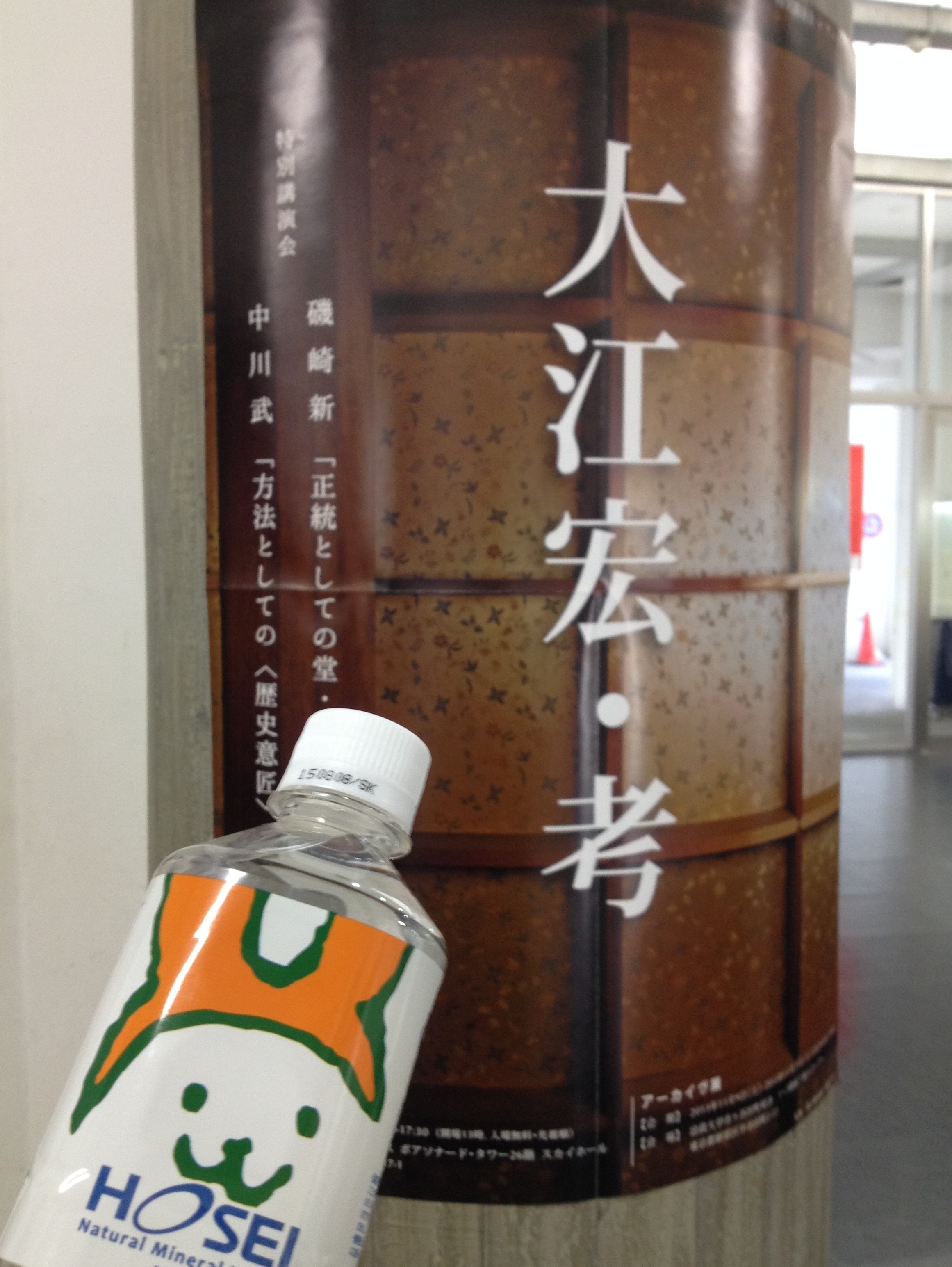
(下記の)写真はゆる〜くなってしまったけど、大いに刺激を受けた。
屋根と間取りのように、建築以外の世界でも(何かと何かの)関係性は重要だろう。

「建築家・大江宏 生誕百年記念事業」アーカイブ展
11月23日(土・祝)まで 9:00〜17:00
法政大学市ヶ谷田町校舎1〜5階展示コーナー


Comments

“大江宏アーカイブ展で、間取りと屋根の関係性を学ぶ” への1,416件のフィードバック

  1. Jerrydexのアバター
    Jerrydex

    Букет с розами и жемчугом – элегантно и дорого выглядело!

  2. DwightCadenのアバター
    DwightCaden

    Доставка спасла мой день рождения в Томске!

    розы томск

  3. TerryTugのアバター
    TerryTug

    Служба доставки цветов Томска сработала так, что даже капризный получатель остался доволен.

    dostavkacvetovtomsk6.ru

  4. Jerrydexのアバター
    Jerrydex

    Ваши розы пахнут, как в лучших французских парфюмах – аромат на весь дом!

  5. EugeneTenのアバター
    EugeneTen

    Профессиональный сервис доставки букетов по Томску. Всё организовано чётко, цветы отличные.

    http://cvety1tomsk70.ru/

  6. Miltonemogsのアバター
    Miltonemogs

    Букет стоял почти две недели, не увял!
    доставка цветов

  7. Miltonemogsのアバター
    Miltonemogs

    Замечательный сервис, всё продумано до мелочей.
    букеты томск

  8. Miltonemogsのアバター
    Miltonemogs

    Букет приехал вовремя, всё свежее и красиво оформлено!
    заказ цветов томск

  9. are steroids bad for you if used properly

    References:
    hedgedoc.eclair.ec-lyon.fr

  10. Its musical content is an instrumental rendition of a well-known popular song. In recent times, lyrics are typically displayed on a video screen, along with a moving symbol, changing colour, or music video images, to guide the singer. In Chinese-speaking countries and regions such as mainland China, Hong Kong, Taiwan and Singapore, a karaoke box is called a KTV. The global karaoke market has been estimated to be worth nearly $10 billion.[2]
    Karaoke’s global popularity has been fueled by technological advancements, making it a staple of social gatherings and entertainment venues all over the world. Karaoke machines made their first appearances in Japan in the 1970s. These machines, along with their popularity, spread worldwide in the 1980s. The machines were mainly featured in lounges, nightclubs, and bars. In-home karaoke machines grew in popularity once they were combined with home theater systems. Over time, karaoke has evolved with digital music, video games, smartphone apps, and online platforms, allowing users to sing anytime and anywhere. Beyond leisure, karaoke is used for professional training in music and public speaking, highlighting its broad appeal and impact on popular culture.
    From 1961 to 1966, the American TV network NBC carried a karaoke-like series, Sing Along with Mitch, featuring host Mitch Miller and a chorus, which superimposed the lyrics to their songs near the bottom of the TV screen for home audience participation.[3] The primary difference between karaoke and sing-along songs is the absence of the lead vocalist.
    Sing-alongs (present since the beginning of singing) fundamentally changed with the introduction of new technology. In the late 1960s and into the 1970s, stored audible materials began to dominate the music recording industry and revolutionized the portability and ease of use of band and instrumental music by musicians and entertainers as the demand for entertainers increased globally. This may have been attributable to the introduction of music cassette tapes, technology that arose from the need to customize music recordings and the desire for a “handy” format that would allow fast and convenient duplication of music and thereby meet the requirements of the entertainers’ lifestyles and the ‘footloose’ character of the entertainment industry.
    The karaoke-styled machine was developed in various places in Japan. Even before the invention of the first machines, the word “karaoke” had long been used in Japan’s entertainment industry to refer to the use of instrumental recordings as backing tracks in situations when a live band could not be arranged for a singer.[4] Japanese engineer Shigeichi Negishi, who ran a consumer electronics assembly business, made the first prototype in 1967;[5][6][7] He subsequently began mass producing coin-operated versions under the brand name “Sparko Box”, making it the first commercially available karaoke machine. For media, it used 8-track cassette tapes of commercially available instrumental recordings. Lyrics were provided in a paper booklet.[8] However, he ran into distribution troubles and ceased production of the Sparko Box shortly thereafter.[9] Despite being credited as the first to automate and commercialize the karaoke singalong, Negishi, who died in 2024, never patented his invention.[10] Another early pioneer was Toshiharu Yamashita, who worked as a singing coach, and in 1970 sold an 8-track playback deck with microphone for sing-alongs.[7]
    In 1971, nightclub musician Daisuke Inoue[11] independently invented his own karaoke machine in the city of Kobe.[12][13] His biggest contribution was understanding the difficulty amateurs had in singing pop songs, recording his own versions of popular songs in keys that made them easier for casual singers.
    As such he also included a rudimentary reverb function to help mask singers’ deficiencies. For these reasons, he is often considered to be the inventor of the modern business model for karaoke, even though he was not the first to create a machine and, like Negishi or Yamashita, did not file a patent.[14] Music has long been part of Japan’s nightlife, and particularly so in the postwar era, when a variety of establishments such as cabarets and hostess clubs emerged to serve the needs of salarymen unwinding and entertaining clients. Music, whether performed for listening or singing along, played a key role.[15] Inoue, a bandleader, drummer, and Electone keyboardist, specialized in leading sing-alongs at nightclubs in Sannomiya, the entertainment district of the city of Kobe.
    He grew so popular that he became overbooked, and began recording instrumentals for clients when he could not personally perform for them. Realizing the potential for the market, he commissioned a coin-operated machine that metered out several minutes of singing time. Like Negishi’s, it was based on an 8-Track cassette deck, and Inoue called it the “8 Juke.”[16] Inoue loaned the machines to establishments for free in exchange for a portion of the monthly earnings from the machines.[17] He placed the first 8 Jukes in Sannomiya’s “snack bars”, but they initially failed to take off. Inoue then hired hostesses to ostentatiously sing on them, which successfully sparked interest. This also caused a great deal of friction with Inoue’s fellow musicians, who saw it as drawing customers away from them.
    Nevertheless karaoke spread throughout Kobe, then, over the course of the Seventies, all of Japan as major manufacturers such as JVC began producing their own versions of the singing machine.[18] Karaoke was long performed mainly in bars and hostess clubs in front of other patrons, but in the 1980s, a new style with private rooms emerged, called karaoke boxes. This became the dominant form of karaoke performance in Japan. In 2004, Daisuke Inoue was awarded the tongue-in-cheek Ig Nobel Peace Prize for inventing karaoke, “thereby providing an entirely new way for people to learn to tolerate each other.”[19]
    The patent holder of the karaoke machine is Roberto del Rosario, who is from the Philippines. He developed the karaoke’s sing-along system in 1975 and is recognized as the sole holder of a patent for a karaoke system in the world.[20]
    Karaoke soon spread to the rest of Asia and other countries all over the world. In-home karaoke machines soon followed but lacked success in the American and Canadian markets. When creators became aware of this problem, karaoke machines were no longer being sold strictly for the purpose of karaoke but as home theater systems to enhance television watching to “movie theater like quality”. Home theater systems took off, and karaoke went from being the main purpose of the stereo system to a side feature.
    As more music became available for karaoke machines, more people within the industry saw karaoke as a profitable form of lounge and nightclub entertainment. It is not uncommon for some bars to have karaoke performances seven nights a week, [25] commonly with high-end sound equipment superior to the small, stand-alone consumer versions. Dance floors and lighting effects are also becoming common sights in karaoke bars. Lyrics are often displayed on multiple television screens around the bar.
    A basic karaoke machine consists of a music player, microphone inputs, a means of altering the pitch of the played music, and an audio output. Some low-end machines attempt to provide vocal suppression so that one can feed regular songs into the machine and remove the voice of the original singer; however this was, historically, rarely effective. Most common machines are CD+G, Laser Disc, VCD or DVD players with microphone inputs and an audio mixer built in, though VHS VCRs are sometimes used.[26] CD+G players use a special track called subcode to encode the lyrics and pictures displayed on the screen while other formats natively display both audio and video.
    Most karaoke machines have technology[27] that electronically changes the pitch of the music so that amateur singers can choose a key that is appropriate for their vocal range, while maintaining the original tempo of the song. (Old systems which used cassettes changed the pitch by altering playback speed, but none are still on the market, and their commercial use is virtually nonexistent.)
    A popular game using karaoke is to type in a random number and call up a song, which participants attempt to sing. In some machines, this game is pre-programmed and may be limited to a genre so that they cannot call up an obscure national anthem that none of the participants can sing. This game has come to be called “Kamikaze Karaoke” or “Karaoke Roulette” in some parts of the United States and Canada.[28]
    Many low-end entertainment systems have a karaoke mode that attempts to remove the vocal track from regular audio CDs, using an Out Of Phase Stereo (OOPS) technique. This is done by center channel extraction, which exploits the fact that in most stereo recordings the vocals are in the center. This means that the voice, as part of the music, has equal volume on both stereo channels and no phase difference. To get the quasi-karaoke (mono) track, the left channel of the original audio is subtracted from the right channel. The Sega Saturn also has a “mute vocals” feature that is based on the same principle and is also able to adjust the pitch of the song to match the singer’s vocal range.
    This crude approach results in the often-poor performance of voice removal. Common effects are hearing the reverb effects on the voice track (due to stereo reverb on the vocals not being in the center); also, other instruments (snare/bass drum, bass guitar and solo instruments) that happen to be mixed into the center get removed, degrading this approach to hardly more than a gimmick in those devices. Recent years have seen the development of new techniques based on the fast Fourier transform. Although still not perfect, the results are usually much better than the old technique, because the stereo left-right comparison can be done on individual frequencies.[citation needed] https://sites.google.com/view/www-adobe-illustrator-cs3-fre
    cc7c31b456 garkafl

  11. A completely new Elementary edition from the world’s best-selling English course, with new digital resources for 2011. This student book features new texts, topics, and design, with an integrated-skills syllabus with a clear grammar focus.
    Such are the daily challenges and triumphs of educating the growing Hispanic enrollment in the Quillayute Valley school district. The school district has historically averaged about 10 Hispanic students, but the number has increased in the past five years to about 70, said Bob Harmon, assistant to the superintendent. The district expects the influx to continue.
    “They come with varying skills,” elementary school principal Sam McElravy said. “Many come with absolutely no English at all, and no education at all. Some come with just Spanish but are fairy well educated. Some speak English. It’s a complete hodgepodge.”
    Juan Carlos Gonzalez, a third grader from Mexico in his second year at Forks Elementary school, who spoke no English when he arrived, had a tough time communicating at first but now feels comfortable at school.
    Gonzalez’ rapid progress is because of his age- it’s easier to teach English to the younger students- and the fact he had some education in Mexico and could read in Spanish when he arrived, Velasquez said.
    Bill Berglund, the middle school principal, said it’s important to help students- especially older ones- adjust to cultural differences. Although educators are usually dubious about commercial television as a learning tool, Hispanic students who watch TV seem to adjust quickest, he said.
    But teachers and classmates helped her to speak and read. At the elementary school, students get small and large group instruction in a special bilingual classroom and tutoring from teaching assistants in regular classrooms.
    On Mondays and Wednesday, students have English reading groups and Tuesdays and Thursdays the reading groups are Spanish. The strategy is to teach English and still maintain a good learning pace of other subjects.
    In high school, students take English as a second language, and this year, English and history classes are taught by the bilingual tutor, Bennett said. Hispanic students often take Spanish class because some aren’t literate in their native tongue, he said.
    One way of boosting Hispanic students is to schedule periods for instruction about other cultures and teaching Spanish as a second language for all students, Much said. During those times, Hispanic students can demonstrate knowledge and get esteem from peers, who learn that struggles may result from a language barrier and not a lack of intelligence, he said.
    An undesired impact of bilingual education is that Hispanic students sometimes abandon Spanish culture and language at home, the educators said. “That creates a little bit of friction with the family,” McElravy said.
    University of Washington. All rights reserved. The Community Museum is a project of community organizations and Tribes across the Olympic Peninsula and the University of Washington. Support for the project comes from the Institute of Museum and Library Services and Preston, Gates and Ellis, LLP.
    Three years ago, we asked: Can it be done � can public schools deliver theresults four presidents have called for? Is there success out there to see?Are there models that the rest of us can learn from?
    We especially wanted to know what school districtswere delivering the bestresults for the weakest students. Had any educators devised models of educationalreform that worked not just for affluent college-bound students, but also forthe larger mass of disadvantaged kids and struggling learners? Was anyone closingthe achievement gap between minority and poor students and the middle classmainstream?
    And, in a nation of 92,000 schools and 47 million students, reform needs toencompass many schools, so we also asked: Is there evidence of success, notjust in a handful of schools, but in hundreds of schools or entire school districts,that are taking tens of thousands, even hundreds of thousands of students tonew levels of performance so that America�s next generation can compete in thenew global economy?
    The answer to all our questions, we found, is yes. But finding the successstories took more than a solid month of talking to education specialists whohad spent years tracking and studying educational results, trying to determineobjectively what works and what doesn�t. We consulted studies and experts fromHarvard to Texas A&M, from the University of Wisconsin and Johns Hopkins toStanford, from the RAND Corporation and The Education Trust to the Council ofthe Great City Schools, from the blue book on school reform of the AmericanInstitutes for Research to the regular test reports compiled by the NationalAssessment of Educational Progress. We asked not
    On the experts� advice, we set tough criteria. First, reform at large scale,not just pockets of progress inspired by dynamic individual leaders. Second,reform with a proven track record over several years. No flash in the pan reformsthat petered out. Third, reform with results that beat rival models, accordingto independent studies.
    The seven examples of reform that made it into our two-hour program have hadbroad impact, changing the performance of up to two million students. They coverall levels, from elementary to high school, from inner city Chicago and NewYork to small towns like Corbin, Kentucky and Mount Vernon, Washington. Andthey reach from east to west in the north, and along an arc across the Sunbeltfrom Charlotte to Houston to San Diego.
    The common denominator is results � measurable improvement, especially fromkindergarten through eighth grade. High schools were a tougher nut to crack,though the one model singled out by experts has a very strong track record.
    The strategies of the four models in the first hour of the program differwidely � from a highly scripted elementary reading program (Success for All)and a program focused on holistic child development (Comer Process) to a radicalmiddle school with sharp discipline and an extra long school year (KIPP), toa program that motivates teenagers with hands-on learning (High Schools ThatWork).
    Among the school districts shown in the second hour, one put its focus onimproving teaching (District 2) in New York City; another, on a data-drivenstandards approach (Charlotte-Mecklenburg); and a third (San Diego) made headwaybut got mired in a battle between advocates of fast-paced, top-down centralizedreform versus those who favored go-slow, site-based school reform.
    Diversity in science acknowledges the potential for greatness in individuals who are underrepresented. It builds relationships and improves our creativity. It improves our work environments and strengthens our interpersonal skills.
    I recently attended a writing workshop with the Initiative for Maximizing Student Development (IMSD) scholars. There was an incredibly productive scientist who described her experiences in STEM and what her career path was like as a Chicana in academia.
    She provided personal examples in which peers discredited her abilities, mentors questioned her intelligence, and colleagues with fewer credentials were promoted ahead of her. Some of the challenges that she discussed are comparable to my own experiences.
    Conversely, she was able to whether the proverbial storms because she was able to build a support system outside of her immediate environment. She also had the wherewithal to allow her science/research to speak for her capabilities.
    Her story reminded me that many individuals from underrepresented groups share similar journeys while advancing through STEM fields. It also spurred me to put together a few thoughts regarding diversity in STEM, what it means to our field/industry, and how diversity affects the individual.
    Diversity refers to variation/differences and consists of many facets, but I will specifically focus on differences pertaining to social identity (socioeconomic status, ethnicity/race, gender, etc.). There are considerable efforts in place to increase diversity in science.
    For example, funding opportunities through the National Institutes of Health (F30, 31,32; R03, R25, etc.), the United Negro College Fund/MERCK, and the National Science Foundation have been established to promote and support funding of historically underrepresented groups in the sciences.
    However, I argue that it would be imperative to begin exposing students earlier in matriculation to research/STEM careers, possibly in elementary school. When underrepresented students recognize and acknowledge that a career in STEM is a viable and rewarding option, we solidify the future of the sciences.
    In addition to starting the conversation sooner with students, I think it would be equally beneficial to prepare mentors in order for them to be able to work with a diverse group. Preparing and training mentors will foster an enriching and welcoming environment for diversity.
    From a very young age, I had opportunities to interact with students from a variety of socioeconomic, ethnic, and racial backgrounds. These opportunities expanded my academic and social aspirations as I learned: how to relate to peers that were different from my neighborhood friends and develop my love for science.
    I attended a diverse elementary school where we frequented the Field Museum, the Natural History Museum, the Shedd Aquarium, and the Museum of Science and Industry. I also attended a diverse high school where: I volunteered at the Museum of Science and Industry, volunteered at several animal clinics throughout Chicago, and taken several AP courses. Were it not for the experiences early in my academic career, I would have been ill equippedfor undergrad and graduate school.
    Although we are making headway, at times, we forget about the needs of the individual. From the lecture that I attended, it was clear that increasing the number of students/faculty from underrepresented groups is not enough. Changing our attitudes will potentially attract and retain underrepresented students/faculty. https://sites.google.com/view/winedt-103-free-link-download
    cc7c31b456 winewin

コメントを残す

メールアドレスが公開されることはありません。 ※ が付いている欄は必須項目です